01 / THE QUICK ANSWER
What does Tawarruq mean?
Tawarruq is an arrangement involving two separate sale-and-purchase transactions. A buyer first purchases a commodity on deferred payment, then sells the same commodity to a third party for cash. In Islamic financing, these commodity sales can be used to generate financing proceeds.[1]
The key questions are simple: who buys the commodity, who owns it, who sells it and how does the customer receive the proceeds? Following that sequence makes financing documents easier to understand.
Not every Islamic finance product uses Tawarruq. Contracts and implementation vary by product; refer to the applicable documents.
02 / FOLLOW THE TRANSACTION
How does Tawarruq work in Islamic financing?
These four steps show a common financing arrangement. They are a learning aid, not a substitute for the terms or transaction records of a particular product.

The financier buys a commodity
A commodity is purchased from a supplier or through a trading platform.
The customer buys on deferred payment
The financier sells the commodity to the customer at an agreed deferred price. In Murabahah, the cost and profit are disclosed.
The commodity is sold to a third party
The customer sells it for cash to a buyer other than the original seller. An authorised agent may handle the sale where the contract permits.
The customer receives the proceeds
The third-party sale generates the customer’s financing proceeds, subject to the provider’s process.
Based on BNM and Jomdana’s official FAQ. The specific Jomdana-i sequence must be read with its financing documents.[1][3]
The deferred sale creates a payment obligation. The subsequent third-party sale generates cash.
03 / WHAT CHANGES HANDS?
Commodity, cash and repayment: three different things.
Commodity ownership and the movement of money are connected, but follow different paths.
AOwnership & sales
- Commodity supplier
- Financing provider
- Customer
- Third-party buyer
BProceeds & commitment
- Cash received
- The third-party sale proceeds go to the customer.
- Deferred payment
- The customer pays the selling price under the contract.
- Total cost
- Review profit, charges and the payment schedule.
Is the cash received the same as the amount payable?

Not necessarily. Cash proceeds and the deferred selling price are separate figures. In a Murabahah sale, the price includes acquisition cost and agreed profit. Check any additional charges and the full commitment in the actual offer.[4]
This educational model does not verify the ownership, price, charges or execution of any individual transaction.
To assess the actual commitment, use the personal financing cost comparison guide alongside your offer.
If you are comparing an offer of around RM500, organise the net cash, scheduled payments and separate fees to understand the actual payment commitment. This calculation does not verify a transaction’s execution or Shariah compliance.
04 / MAKE SENSE OF THE TERMS
What is the difference between Tawarruq and Commodity Murabahah?
Tawarruq describes the overall arrangement; Murabahah describes a cost-plus-profit sale. A Commodity Murabahah sale may form part of Tawarruq. In Malaysian finance, both names are also sometimes used for the overall structure.[1][4]
On a small screen, scroll the table to compare.
| Aspect | Tawarruq | Commodity Murabahah |
|---|---|---|
| Focus | The sale sequence used to obtain cash. | A commodity sale with disclosed cost and profit. |
| Mechanism | A deferred purchase, then a cash sale to a third party. | A selling price based on acquisition cost plus agreed profit. |
| Relationship | May include a Murabahah sale within the arrangement. | May name a sale component or, in local usage, the wider arrangement. |
| Review | Parties, sequence, ownership and transaction records. | Cost, selling price, profit and payment terms. |
And what does Wakalah mean?
Wakalah is an agency arrangement for specified tasks. In some Tawarruq structures, an authorised agent handles a commodity sale for the customer, subject to the relevant contract and permission.[5]
05 / BEFORE YOU AGREE
Five questions to check against your offer.
Tick only what you have understood from the documents or the provider’s explanation. Use the remaining questions to ask for clarification.
0 of 5 items checked
Ticks apply to this visit only. This is not an eligibility assessment or Shariah certification. The cited BNM ruling concerns Tawarruq via STP specifically; it does not verify each Jomdana transaction.
06 / THE JOMDANA-i CONNECTION
How is Tawarruq used in Jomdana-i?
Jomdana’s official FAQ describes Jomdana-i as Shariah-compliant personal financing using Tawarruq / Commodity Murabahah. Sedania provides the platform that facilitates and records the relevant commodity trades.[3]
The FAQ also describes authorisation for the company to handle permitted trading tasks on a customer’s behalf. Customers may request relevant records or certificates, subject to operational procedures.[3]
When are financing proceeds released?
The FAQ lists approval, document execution, Tawarruq transactions and operational verification as requirements before disbursement. Timing can vary; neither approval nor disbursement within a fixed period is guaranteed.[3]
If disbursement timing matters to your decision, review the difference between applying, approval and receiving funds.
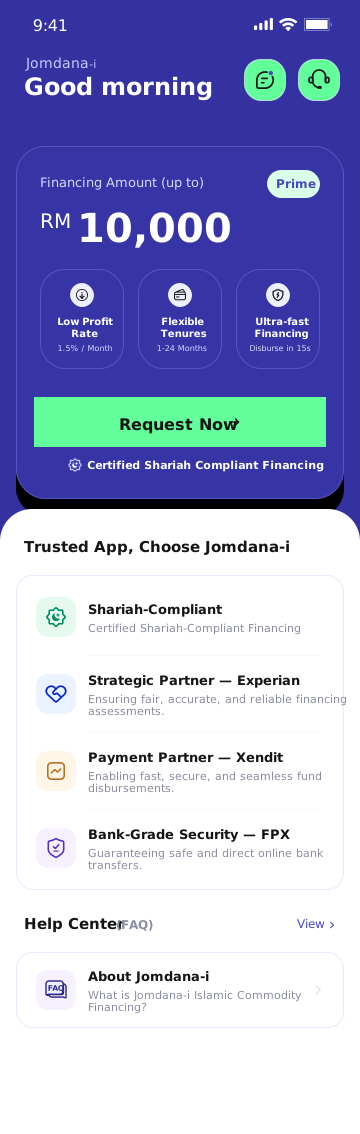
JOMDANA-i
Understand the structure. Then review the actual terms.
Explore the financing details, documents and payment commitment before requesting financing through an official digital channel.
Subject to assessment, documents and current terms. Approval and disbursement are not guaranteed.

07 / COMMON QUESTIONS
Frequently asked questions about Tawarruq
Is Tawarruq the same as a conventional personal loan?
Not in its contractual structure. Tawarruq uses commodity sale-and-purchase transactions, whereas a conventional personal loan follows a lending contract. You should still compare payment obligations, total costs and actual product terms before deciding.[1]
Are Tawarruq and Commodity Murabahah the same thing?
In Malaysian finance, the names are sometimes used interchangeably for the overall arrangement. More precisely, Tawarruq focuses on the two-sale sequence that generates cash, while Murabahah is a cost-plus-profit sale that may form part of it.[4]
Is every Tawarruq transaction automatically Shariah-compliant?
Do not assume so from the name alone. Execution, asset identification, ownership, documentation and contractual requirements matter. An arrangement must be assessed against its actual contracts and transactions; this guide is not a certification of compliance.[2]
Why is the commodity sold to a third party?
The second sale lets the commodity’s owner obtain cash proceeds. A third-party cash sale is a defining part of the general Tawarruq arrangement described by Bank Negara Malaysia.[1]
Do Jomdana-i customers have to sell the commodity themselves?
Not necessarily. Jomdana’s FAQ says customers may authorise the company to perform specified commodity-trading tasks on their behalf, where the financing arrangement permits.[3]
Can I request commodity transaction records?
Jomdana’s official FAQ says customers may request relevant commodity trading records or certificates, subject to operational procedures. Use Jomdana’s official channels for a specific request.[3]
Does using Tawarruq mean a financing request will be approved?
No. Tawarruq explains the financing structure, not a customer’s eligibility. Jomdana-i requests remain subject to the applicable financing assessment and process; approval is not guaranteed.[3]
08 / SOURCES & EDITORIAL NOTES
Read the original explanations.
General concepts draw on Malaysian primary sources. Jomdana-i details refer to its official FAQ and product page. This guide does not verify individual transactions.
- Bank Negara Malaysia — Commodity Brokers
The definition and basic Tawarruq sequence.
- Bank Negara Malaysia — SAC, 199th meeting
Ruling released 19 May 2020 on Tawarruq via Straight-Through Processing (STP); not verification of Jomdana transactions.
- Jomdana — FAQ
The product structure, Sedania, agency, records and disbursement.
- Bursa Malaysia — Murabahah & Tawarruq
Murabahah definitions and Malaysian terminology.
- Bank Muamalat — Cash-i SMART
General Wakalah terminology; not evidence of Jomdana’s agency arrangements.
- Jomdana-i
Official product information for further review.
Prepared by Jomdana Content Team · Editorial policy
Public sources checked: .
Specialist Shariah and Compliance review of this article is pending.
This is general education, not personalised financial, legal or Shariah advice. Implementation, profit, charges, eligibility and contractual rights depend on the product and current documents. Review the latest information and seek clarification through official channels before accepting an offer.